
One of the most surprising qualities about a good road trip is not what is found at your destination, but what you find when you veer from a carefully mapped out route into the unknown. Earlier this week, I was making tracks in my trusty Honda out of Washington, DC, with the family when we decided a detour was in order. There had too much time behind the wheel, and not enough time exploring our surroundings. Charlottesville, Virginia, wound up being our stopping point for six hours and we experienced more there in a short period of time than I did over multiple days in the District.
First stop
First stop was the University of Virginia. Founded in 1819 by Thomas Jefferson, UVA opened in 1825. Jefferson considered it to be one of his greatest achievements. As we traversed the grounds, searching for Edgar Allen Poe’s room on campus, didn’t have to stretch my imagination to know we were walking in the footsteps where great leaders had, and will continue, to walk.

The great Rotunda was closed for renovation, but there were sections of glass to look through on the construction barriers to see the foundation and work being done to ensure this historical structure will be standing for many generations to come. All old buildings hold secrets, and the Rotunda held its own surprises. One is a chemical hearth, part of an early science classroom. It had been sealed in one of the lower-floor walls of the Rotunda since the 1850’s and was protected from the 1895 fire that destroyed much of the building’s interior. Two small fireboxes of the same hearth were uncovered in a 1970’s renovation, but the hearth itself remained hidden until the current round of renovations.
While visiting, stop in at the Albert and Shirley Small Special Collections Library. The library’s trove holds more than 16 million objects including manuscripts, archival records, rare books, maps, broadsides, photographs, audio, video and more. I was fascinated by the current collection on display of 72 American Broadsides –single-sheet publications typically printed on a single side. These rare items cover matters political, religious, social, commercial, militaristic, and literary. My husband and son were not as fascinated and opted to stay outside and watch the football game on the lawn outside the building.
Jefferson was a visionary who sought a new kind of university. He wanted to educate leaders in practical affairs and public service. Up until that time, most educated men found themselves relegated to the classroom or pulpit. Public schools were few and far apart, and wealthy parents sent their children to private school or hired tutors at home. It would not be until the mid-1800’s that most states had accepted that school should be free and supported by taxes, allowing for growth at universities like the University of Virginia, and more careers that would require educated men and women.
Second Stop:
Michie Tavern is the place to stop if you’re looking for a hearty lunch to hold you during your visit. Opened in 1784 as an Ordinary by Corporal William Michie, the Tavern will fill your stomach with delicious food and your mind with images of Colonial American history. Located less than two miles from Monticello, Michie Tavern offers rustic Southern fare punctuated with the ambiance of an 18th-century inn.
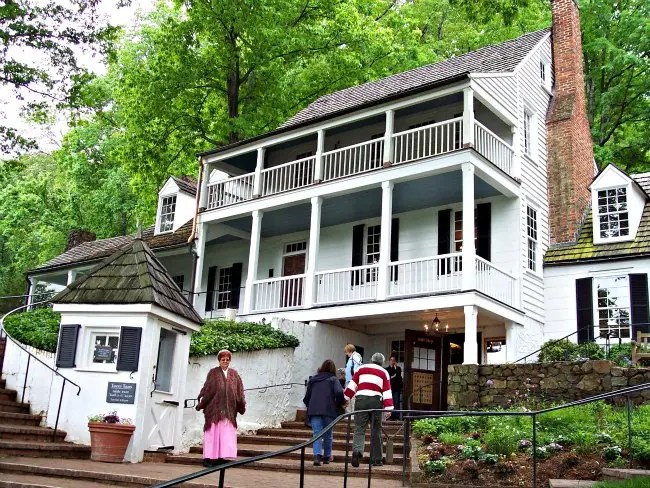
We enjoyed a lunch buffet of fried chicken and hickory smoked pulled pork BBQ along with a host of sides that included mashed potatoes and gravy, stewed tomatoes, whole baby beets, and fluffy biscuits. As we sat in The Ordinary (the main dining room), our waitress was dressed in period attire, and with a platter of hearty fare in front of us, it wasn’t difficult to imagine life in Colonial Virginia.

Third Stop:
Monticello is only a few miles drive from the University of Virginia. We took in the fall colors while listening to the leaves rustle in the early afternoon breeze, and it was easy to see why Jefferson had picked Charlottesville for his home and university.

Monticello, also known as Thomas Jefferson’s “Little Mountain,” is the only home in the United States recognized as a UNESCO World Heritage Site. Walking through the 45,000 sq ft visitors center, there was a mind-boggling amount to take in and absorb. Yet, it was the first glimpse of Monticello that left me breathless.

By Martin Falbisoner (Own work) [CC BY-SA 3.0], via Wikimedia Commons
Touring Monticello and the grounds is a full day event. As we were short on time, we opted for the basic tour. The tours are informative and do not avoid the subject of slavery in the United States. There are constant reminders everywhere of the slaves that lived at Monticello and their roles in the building, maintenance, and care of this vast expanse of property.
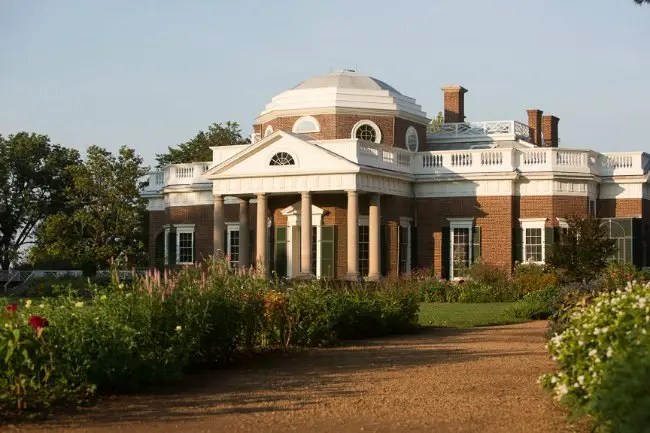
I’ll be heading back to Monticello in early Spring to take part in the Hemings Family Tour to learn more about life during the time of slavery. This tour teaches how the Hemings’s made choices to survive, resist, and escape the everyday realities of slavery. During the tour, visitors begin to understand the harsh meaning of race and slavery at the home of Jefferson.

Fourth Stop:
Ash-Lawn Highland is a few miles from Monticello and was the home of fifth U.S. President James Monroe and his wife, Elizabeth from 1793-1826. Owned and operated by Monroe’s alma mater, The College of William and Mary, Highland is now a historic house museum with a 535-acre working farm that also doubles as a performing arts site throughout the year.

Highland is a shocking contrast after visiting Monticello and being immersed in 18th-century grandeur. It’s nineteenth-century farmhouse is not uncommon to the many houses you see along Hwy 64 and 81 leading to Charlottesville. The home showcases a trove of objects original to President and Elizabeth Monroe, French furnishings imported during the reign of Napolean, and American treasures. The Duncan Phyfe mahogany bedroom furniture was easy for me to distinguish, due to my love of his craftsmanship (and a friend who mistakenly distressed two of his tables, not knowing the history of them).
Earlier American designs such as a Windsor rocker and mid-eighteenth-century table are also on display. The imported English styles you’ll see include a bow-front china cabinet and a set of eagle-back chairs dating to the time of George III (1738-1820).
Monroe’s home is a cultural trove of elegant furnishings and I could have spent all day admiring furnishings and decor by creators such as Hepplewhite, Phyfe, Aubusson, Davies, and Zuber. It was a virtual treasure trove of European elegance and American craftsmanship.


The grounds at Ash-Lawn Highland are vast and in 1798, Monroe predicted he could grow 20,000 pounds of tobacco. He used farming methods only being reintroduced today for modern sustainability farming, such as planting cover crops, and plowing gypsum into the soil to boost the soil productivity.
Like Jefferson, Monroe was no stranger to slavery. While he wasn’t an advocate for equal rights of all, he sought a gradual end and resettlement of enslaved men and women in the Caribbean or Africa. His home’s survival depended on slave labor, just as all of his wealthy landowning neighbors did.
Torn between his belief in the evils of slavery and his fear that immediate abolition would result in mob violence and race wars, Monroe came to believe that colonization was an effective means of reducing, and ultimately eliminating, slavery in the United States.
Final Stop:
As we were ready to head down the mountain, my teen was complaining of hunger (as all teen boys are want to do) while we were stopped for gas at the Market at Bellair. This was the biggest surprise of the trip, as the Market was quite possibly one of the best sandwich shops I have ever had the pleasure of visiting. Never mind that it is inside an Exxon.
While my husband fueled up the car, I was able to create a meal for our family to have during our drive home that included gourmet sandwiches, Caprese salad, black bottom muffins, and a perfectly poured latte to fulfill my immediate need of caffeine.
There is so much more to write about this trip and each individual location along my route. The issues that slavery posed during the times of Jefferson and Monroe are topics I certainly want to delve more deeply into, as it is part of the history of the United States. It’s important for people who are traveling to see how these historic homes and foundations are addressing these issues and making sure that a balanced effort is put into place to share life as it truly was, and not hide what is a sordid mark on our history. It is even more important to me, as a white travel writer, to try and learn from this past, and let the places I visit know that independent observers, like me, want to know the real, raw history and for it not to be whitewashed and left unmentioned.
Many thanks to the Thomas Jefferson Foundation at Monticello and Ash-Lawn Highland for allowing me to use the photos you see here of Monticello and Highland with express permission. Unfortunately, SD Card corruption is a fact of life and their graciousness allowed me the opportunity to share images of these beautiful homes.
Visit Charlottesville:
University of Virginia Historical Tours are offered every day at 10:00 a.m., 11:00 a.m., 2:00 p.m. Tours begin in the Harrison Institute/Small Special Collections Library
Eat: Michie Tavern
Grab a snack: The Market at Bellair
What to Wear: Comfortable walking shoes, Layers
Additional Tips: Bring a water bottle, mosquito repellent (for summer days) and don’t forget your sunscreen.
Travel Savings:
Save money by buying The Monticello Neighborhood Pass (formerly the Presidents’ Pass). This is a discounted combination ticket* for James Monroe’s Ash Lawn-Highland, Thomas Jefferson’s Monticello, and the historic Michie Tavern museum. The ticket is available for purchase at all three Charlottesville-area attractions or online at the Monticello website. Prices include a $6.oo savings for adults!
Adults (March 15 through October) – $40.00
Adults (November through March 14) – $34.00
Children ages 5-11 (year-round) – $18.00
Eat at the Michie Tavern:
Adult Buffet: $17.95
Youth Buffet (12-15) $10.95
Youth Buffet (6-11) $6.95
Vegetarian Buffet Discounted Rate: $10.95
One child under six eats free for each paying adult
Lunch is served daily 11:15am-3:30 p.m. April through October and 11:30-3:00 November through March
Visit Monticello:
Address: 931 Thomas Jefferson Pkwy, Charlottesville, VA 22902
Admission:
$25 — Adults March-October
$20 — Adults November – February
$8 — Children 5-11
Free — Children 5 and under
Hemings Family Tour
$27 — Held on Sundays and Tuesdays at 9:15 a.m., March – October
Visit Ash-Lawn Highland:
Address: 2050 James Monroe Parkway Charlottesville, VA 22902
Admission:
Adults and Seniors
$14 — Adults (Tours before 10 AM Memorial Day through Labor Day: $10.00)
$12 — Seniors (60 and older)
$13 — AAA Members with ID
Youth
$8 — Youth ages 6-11
Free — Youth under 6
Military
Active U.S. Military and dependents with ID – FREE Memorial Day to Labor Day through Blue Star Museums extended to up to five family members
$12 Active and Retired U.S. Military with ID extended to one accompanying family member
Community Members
$8 — Local Residents (including residents of Charlottesville and Albemarle, Augusta, Buckingham, Fluvanna, Greene, Louisa, Nelson, Orange, and Rockingham counties) (one FREE admission with paying out-of-town guest)
FREE — College of William & Mary Faculty and Staff
$8 — College of William & Mary Students
$8 — University of Virginia (Faculty, Staff, & Students)
Groups
$12 Adult Tour Groups (minimum of 10)
